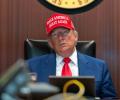
'What the Americans want is to destabilise Iran. For destabilising Iran, you need access. 'One access is through Iraq. The other access is through Pakistan.'
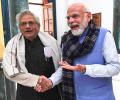
Sitaram Yechury strived to have the country's Left movement shed its doctrinaire approach to India's socio-cultural complexities and stitch electoral and social alliances to fight the Sangh Parivar.

Trump couldn't care less anymore about the Israeli demand for Iran's 'de-nuclearisation' and 'de-militarisation.' Trump pins hopes on a grand bargain with Iran as a partner in America First, argues Ambassador M K Bhadrakumar.
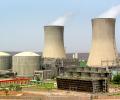
'Chinese are going bang, bang, bang building 30-35 reactors.' 'We should announce a programme of 50 new reactors and show that we mean business on the ground and not just announcements.'
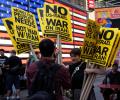
Israel's aerial assault on Iran is widely viewed as an act of naked aggression with no basis in international law, carried out unilaterally despite US opposition and aimed at derailing ongoing US-Iran nuclear negotiations, observes Ambassador M K Bhadrakumar.
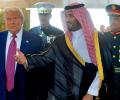
Acutely conscious that he's left with less than four years to create his legacy, Trump is undoubtedly a man in a hurry, observes Ambassador M K Bhadrakumar.
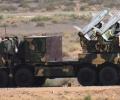
'The devastating Indian Air Force strikes on the night of May 9-10 exposed Pakistan's vulnerabilities.' 'If these had continued, it would have further degraded Pakistan's ability to continue with air operations.'
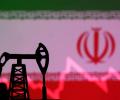
The United States has imposed sanctions on at least half a dozen Indian companies accused of trading in Iranian petroleum and petrochemicals as part of broader action targeting 20 entities worldwide.

British Prime Minister David Cameron's recent comments in Bangalore on the "export of terror" by Pakistan have enormously pleased the Indian strategic establishment, but the fact is that India is already gearing up for the November visit of US President Barack Obama and is keenly aware that there is nothing like a defence deal to sweeten the mood.
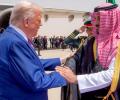
'I said, fellas, come on, let's make a deal, let's do some trading, let's not trade nuclear missiles, let's trade the things that you make so beautifully, and they both have very powerful leaders, very strong leaders, smart leaders, and it all stopped.'
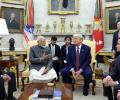
'As one former Indian diplomat put it to me, Delhi has access to the White House, but Islamabad has access to Mar-a-Lago.'

The blame must be shared by the investigating agencies, the government of the day and the nation at large, points out Colonel Anil A Athale (retd).
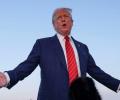
United States President Donald Trump on Tuesday said India has not been a good trading partner and announced that he will raise the tariffs on New Delhi 'very substantially' over the next 24 hours because it is buying Russian oil.

There are many reasons for Japan to turn a deaf ear to its anti-nuclear lobby and concentrate on its geo-strategic imperatives to sign the nuclear deal with India, says Debalina Ghoshal.
With billions of dollars in military technology agreements likely to be made with the United States-India nuclear deal going through, there's an excited buzz among American companies.
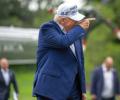
Trump has repeatedly claimed that he "helped settle" the tensions between India and Pakistan and that he told the nuclear-armed South Asian neighbours that America would do a "lot of trade" with them if they stopped the conflict.

Decisive action has replaced dossiers and the new India can go to any extent to uproot terrorism, Defence Minister Rajnath Singh said on Monday while stating that Operation Sindoor was on pause as the armed forces had achieved the desired objectives.

Another special flight carrying 296 Indian nationals and four Nepalese nationals stranded in conflict-hit Iran landed safely in New Delhi on Wednesday, taking the total number of people evacuated under Operation Sindhu to 3,154.
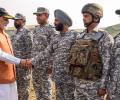
With United States President Donald Trump reiterating his claims of brokering a ceasefire between India and Pakistan, the Congress on Wednesday asked what do the 'typically loquacious' Prime Minister Narendra Modi and External Affairs Minister S Jaishankar have to say about this revelation and did they 'mortgage' India's security interests in the face of US 'pressure'.

There was no reference to trade in talks between top leaders of India and the United States during the India-Pakistan military conflict, government sources said on Monday after American President Donald Trump claimed that he pressured New Delhi and Islamabad to stop hostilities by threatening to cut trade with both countries.
If the US' renewed closeness with Pakistan ends up strengthening Pakistan's military, it will clearly show that Washington no longer wants a strong India and could be ready to let China dominate Asia, notes Colonel Anil A Athale (retd).

The formulations in the declaration in reference to terrorism is going to be to our "satisfaction", Dammu Ravi, secretary (economic relations) in the external affairs ministry said on Monday.

By threatening to punish India with high tariff, Trump is actually planting a tantalising thought in the Indian mind that the Modi government should suitably 'incentivise' him, explains Ambassador M K Bhadrakumar.

We have nothing to gain by raising our concerns internationally as our narrative has got entangled with several controversial concepts in the United Nations, asserts Ambassador T N Sreenivasan.
United States firm Westinghouse Electric and the Nuclear Power Corporation of India Ltd on Wednesday signed a preliminary pact for an Early Works Agreement for installation of the first 1,000 MW American nuclear reactor in India under the historic 2008 Indo-US civil nuclear deal.
United States Secretary of State Condoleezza Rice on Monday spoke to External Affairs Minister Pranab Mukherjee over telephone about the bilateral nuclear deal. During the conversation, Rice conveyed to Mukherjee that the US was keen on moving ahead with the civilian nuclear deal, informed State Department spokesman Sean McCormack. McCormack said, "She (Rice) still supports it going forward. We have conveyed that to the Indian government at a number of different levels."
The stage may be set for a recalibrated US-Iran relationship, suggests Ambassador M K Bhadrakumar.

'Trump's sons, and the son of Trump's Mideast envoy Steven Witkoff, are in the crypto business and recently signed deals with Pakistan's crypto council.' 'It may not be coincidental that not long before the Trump-Munir meeting, the head of Pakistan's crypto council met with Trump's White House crypto policy czar.'

'The protection of secrecy and anonymity gets lost with this linking.'
Pakistan's Foreign Minister Shah Mehmood Qureshi seems to be in a denial over failure in getting a commitment from the US the civilian nuclear deal.
Pakistan has warned the international community that any military moves by India shall be 'responded to assuredly and decisively... onus of any escalatory spiral and its consequences shall squarely lie with India.' Implicit in the statement is a veiled threat that even a nuclear threshold may be reached if push comes to shove, warns Ambassador M K Bhadrakumar.
From bhikshus of Ashokan 3rd century BC and medieval Sufis to Oxfam, Omidyar and Soros now, non-State actors have any real power only when they work in conjunction with a real State, asserts Shekhar Gupta.

'We are too important to want to be paired with Pakistan but too intensely connected to it to successfully detach ourselves,' asserts Aakar Patel.

So far, most of the injured have been released. Currently, 106 people are being treated in hospitals, and another 149 are being treated in the emergency room.
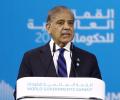
Sharif said that the US president had shown beyond any doubt that "he is a man for peace... and beneficial business deals".
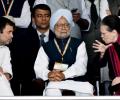
He drew the roadmap of India's economic reform, unshackled it from the licence raj and pulled it back from the brink when even its gold reserve was pledged.
